Showing posts with label korean language/writing. Show all posts

Friday, November 4, 2011

The Adventures of Caity Teacher at EIC

A few weeks ago, I was fortunate enough to participate in Gwangju’s own English Immersion Camp program, also known as EIC. (I will not call this “EIC Camp”, because that is redundant. “English Immersion Camp Camp.” Like “ATM Machine / Automatic Teller Machine Machine.” Not cool.) The camp is in the countryside just outside of town. A group of 30 of the “best” third-year middle school students from all over Gwangju are sent to spend five days speaking nothing but English. The camps are divided by gender, and I worked during a boys’ week. To herd these students and make sure they leave with hyper-stimulated language centers in their brains, three native Englishee teachers are brought in from various public schools to help the native Englishee teacher who is regularly in charge of the camp. That basically means that we showed up, followed the pre-determined plan, and ensured that each student was sore in both brain and body. Yes, body - they had to do pus-ups, squats or run laps if they spoke Korean. Which, during our camp, was fairly often. It’s amazing how such smart kids can be so dense sometimes.

It took about a day for the kids to get used to each other and start goofing around, but by the second day they had already established some interesting nicknames for each other: Giant Messi (the fat kid who liked soccer), Real Messi (the kid who was actually good at soccer), Grandma (something about his permed hair cut), Brother (the kid who looked older than all the rest), Monkey (take a wild guess), Super Strong Stick (use your porno-imagination), and Secret Power (another masturbation reference - go figure, they’re middle school boys). Grandma changed to American Grandma as soon as he picked up the toy shotgun. Interesting how these stereotypes can be so pervasive in the world.


Speed quiz
As with every group, there was also The Crazy Kid. That was our nickname for him, not one from the other students. The early teenage years are filled with drama for everyone, but this kid took it absolutely over the top. Everything was a crisis, and Jimmy Teacher ended up talking him down at least once each day. He was clearly extremely intelligent, but also extremely socially awkward. Personally, I went from feeling sorry for him to thinking we might be able to stem his outbursts by not paying attention to them. (Mainly because I was swiftly losing patience with him. This, friends, is why I’m not cut out to be a teacher.) But it soon became clear that wouldn’t work, and our main concern was just getting him home in one piece before he went mental with the toy shotguns. I suspect there were some legitimate emotional health problems, but in Korea, these sorts of things are routinely ignored and the sufferers very rarely receive the treatment and support that they need. Jimmy tried, bless his heart, but what can anyone really do in the space of just five days, especially when there are 29 other students to tend to?

There were many activities that filled the 60 hours of teaching time. The boys were divided into four groups - one group per teacher - to make English movies. I got the best group, who decided to do an action film. The other groups’ movies all had something to do with zombies and/or masturbation. Go figure.


Another of my favorite activities was the speed interview. Three teachers sat in the office and the students had to come in one at a time to answer as many questions as they could in the space of two minutes. And these were not normal questions that they had encountered before in their English classes. Oh no. These were the stupidest, most random questions we could think of: What’s the best name for a dragon? Why did you eat your cat? How old is your husband? Why do you hate David Teacher? Why did you steal my car? Some kids picked up on it quickly and rolled with it, coming up with some fantastic answers and even stringing some ideas along through the entire interview. One decided to answer each question as though he were the President of the U.S. Others just looked at us like we were crazy. They usually weren’t the fun kids, anyway.


Practicing for presentations
On the last full day, each student group had to present a project that they prepared on some aspect of environmentalism. I was quite impressed with their presentations. Not only was the speaking reasonably good, during the Q&A at the end of each presentation the students asked and answered some excellent questions. They were clearly thinking deeply about the subjects, and were able to express themselves in English, a language so radically different from their own. All this at the age of 15. I’m not sure I could’ve done as well when I was in middle school! It was inspiring to see Korea’s next generation honing their critical thinking skills. The Korean economy has skyrocketed in the past 50 years, and in many ways its society has struggled just to embrace their new prosperity and the vastly different lifestyle it has brought. It’s hard to fathom the drastic change that has taken place here in such a short period of time. And social constructs always lag behind progress in any society, so it’s encouraging to see this generation progressing so rapidly. Despite their goofing off, whining, obsession with masturbation and occasional denseness (i.e. being teenagers), these kids really are the the leaders of Korea’s future.


All in all, it was easy work and good fun, even if we were exhausted after spending nearly 12 hours with the kids each day. It was also extremely refreshing to hear almost nothing but English all week, and to have the kids genuinely trying to communicate with the teachers and (gasp!) each other in English. Oh yeah, and not having “hello!” shouted at me 200 times a day (I’m not exaggerating, and it gets old fast). While it’s been a bit difficult to return to the world of  “average” students, it was inspiring to spend a week with these kids and catch a glimpse of what Korea’s future has in store.


Friday, July 8, 2011

I'm leaving on a jet plane.....

...but I do know when I'll be back again!

My exploratory committee has informed me that I have enough support to secure another contract with EPIK, and I have decided to embrace that opportunity. In order to win over the hearts and minds of the people, I will be home for a 3-week visit in August before coming back to start my new contract/finish out this school year. (Korea runs on a calendar school year, so summer break is really mid-year.) The Caity Teacher Non-Korean U.S. Tour will be making stops in and around Northeast Tennessee, Washington, DC and Maryland's eastern shore. Please see Facebook for dates and times of public appearances. Campaign donations will be accepted in the form of Mexican food, nice cheese and alcoholic beverages. (And of course, actual money. Plane tickets to the U.S. in August are no joke, y'all!)

Now, you might be thinking to yourself, "Why should I support this woman? She's really been letting me down when it comes to regular blog posts recently." Well, I have heard your voices and this is what I have to say: I've been really busy preparing myself to be the best Native Englishee Teacher, and the best person, that I can be. Here's what I've accomplished in the past month or so:
  • I planned and executed what I firmly believe was a successful open class. Feedback was positive from all arenas: Office of Education representative, Korean teachers and other native teachers. Well, I'm kind of guessing that the feedback was positive from Korean teachers because, though they can all presumably speak English, they of course gave their feedback in Korean. For 15 minutes each, followed by a 2-sentence translation from my co-teacher. Not sure what got left out, but at this point I don't really care.
  • I paid a diplomatic visit to the Demilitarized Zone and subsequently drafted a motion to have all South Korean breweries taken over by North Korean brewers. Daily life might generally suck for North Koreans, but at least they have decent beer to knock back after a hard day at their state-sponsored jobs. I believe that this privilege should be extended to all citizens of the Korean peninsula. Good, affordable beer is a basic human right, and Cass and Hite just don't cut it.
  • I attended two Native Englishee Teacher retreats at Myeongsasimri Beach in Wando. We discussed superior teaching strategies, how to keep the peace within our borders, and ways to improve and expand our territories....sort of.
  • I conducted historical research in the city of Gyeongju, learning about leadership from the Great Shilla Kings.
  • I attended a summit of EPIK teachers in Boseong, inspected some green tea fields for their efficiency, and acted as a mediator in the disputes between local crabs and mudskippers.
  • I signed my new contract and successfully navigated the bureaucracy of the Gwangju Immigration Office on my own. The strange thing is, it was significantly more difficult to get the required drug test done at the hospital than it was to navigate the red tape of visa renewal. In fact, the immigration office was a remarkably timely and not-unpleasant experience. Kudos, Korea.
  • I kicked off the season of goodbye parties for those brave and honorable folks who have served their schools well and are now returning to their respective homes. They will be greatly missed.
  • I attended an international celebration of American Independence Day, forging lasting bonds with representatives from England, Ireland, Canada and South Africa, and introducing them to the American wonders of deviled eggs and apple pie.
  • I completed my second Korean language course, thus allowing me to awkwardly communicate with Koreans in a slightly more effective way. We shall see on Tuesday whether or not I will get official credit for this (i.e. whether or not I passed the damn final exam).
As you can see, I have been working diligently to become the best that I can be. I hope that you will be able to overlook my blogging delinquency, and throw your support behind me once again!

In a future post, I will explain in detail my positions on certain key issues related to English education in Korea. In the mean time, may God bless the pilots who will be flying me home.


Sunday, June 12, 2011

School emails according to Google Translate

Korean and English are very, very different. And they're not only different in the obvious ways - writing system, vocabulary, basic sounds. They also have nearly opposite sentence structure and entirely distinct approaches to verb conjugation, the use of articles, and even which words need to be included in a sentence at all. This is on top of the divergent cultural approaches to linguistic expression. In short, Korean and English are, appropriately, about as different as East and West.

And that is why, despite its valiant efforts to accurately translate from Korean to English, Google Translate often spits out some of the most nonsensical and hilarious sentences I have ever seen. That said, it is still the easiest and most reliable method that I have for translating inter-office school emails, so I continue to use it. My daily Google translations have become more of an entertaining pastime than an actual information-gathering activity these days, so I thought I'd share with you some of the better snippets I've collected. Google translations are in italics; my thoughts/interpretations are added in plain text.

If you're a 10,005-year-old children, school staff refer to official documents, please contact your office

We don't take kindly to mummy-students in the classroom. They require more paperwork than normal students.

Concerts ever since the resurrection of the teachers.

Zombie musician teachers!!!!

I think that our school will make shine gloriously.

This sounds more like it should have been written in North Korea.

Check the status of clean and ask the map to go to class.
Uneducated maps will lead our students astray.

Student Ministry ovule is zero.
Um.......

To establish availability and expertise of our colleagues held hostage every time the kidney will be OK.
If you have healthy kidneys, your most expert and available colleagues will be abducted by terrorists.

Lee, Jin Sam's moans, the office ...
The reason
So do not you come in each subject's test range .....
Please help the tears to cease .....

Seriously, guys, get within those subjects' test ranges or this woman is never going to stop moaning.

Two won by modifying the objective Taxonomy send back riohni
Because subjective taxonomy is just unscientific.

For information contact, our Chairman of the teacher to contact you when the Nordic Council session to say how you want to rust.
I would like to rust slowly into a nice burnt-orange color that brings out my eye color.

Hard to do two days rest to start a new Monday ildeulgo many hair pushed hard for everyone is not working well right? There are no see pony up more jobs.
The hair pushing isn't keeping everyone busy enough. Better find more jobs to give them.

Clean the area around the ruins remain drawn out sludge schools are a lot of things to do.
Sludge schools are commonly found in sewers and at the bottoms of ponds.

Teachers need to please take advantage of you.
It might be wise for me to quit soon if this email has been translated correctly.


Tuesday, March 15, 2011

WHOOSH!

One day, while I was sitting in my local 김밥천국 chowing down on some 돌솥 비빔밥 and wondering whether to go drinking at Speakeasy or Soul Train that evening, the Six Month Mark whizzed past me with barely an “안녕”. (The Six Month Mark is kind of rude.) In three days, I will have been in this country for 7 months, a fact I’m having difficulty getting my head around. I’m more than halfway through my stay here and I feel like I barely have my act together enough to navigate daily life like a semi-normal person. And now, with my head still spinning from the passing of month #6, I’m already being asked whether I will be leaving or renewing my contract. This is not a good question. In fact, I refuse to answer that question. I am going to sit here, inert, until the universe hands me the answer on a divine silver platter. Put that in your pipe and smoke it, EPIK.

In the mean time, school has begun again, and with it another round of Find the Open/Cracked Door/Window and CLOSE IT So It's 3 Degrees Above Freezing Rather Than Just 2. Although with spring slowly making its entrance, it is now frequently colder inside the school than it is outdoors. Much colder. Figure that one out. I suspect it has to do with buildings in Korea somehow being made entirely of poured concrete, which grips the cold like the hand of death and stingily holds onto it until summer arrives and then *poof!* suddenly we’re all sweltering again.

This semester has brought a few changes with it. I am now working at two schools instead of just one, like most people in EPIK. This means I spend three days at my main (old) school, two days at my visiting (new) school, and get paid an extra 100k won per month just to walk a bit farther two days a week. I’m teaching four more hours than I did last semester, but so far the only thing being negatively affected is my Facebook presence. I don’t really have much more lesson planning to do, which is good because I never did get any planning done over the break. I teach grades 2 and 3 at my main school and grades 1 and 3 at my visiting school, but I’m teaching one of the two grades at each school straight from the textbook. This is not my idea, mind you. I find the textbook material more than a little bit boring, but the regular English teachers are having a hard time getting through all of the material, so it falls to me to pick up the slack. Not only does this cut down on lesson planning, it also helps make up for the fact that, after two months off, I’ve forgotten how to teach (not that I really ever learned).

There are definitely some perks to being the new teacher again this semester, at least for two days of the week. More curious students staring at my eyes, screaming “I love you!” in the halls, telling me that I’m pretty and giving me candy (even though they’re not in any of my classes). With 6 months of teaching under my belt, I knew what pitfalls to watch out for in the first weeks, and I hope I’ve begun on a better foot with my visiting school students than I did with my main school students last semester. Only time will tell if I can hold it together or if this is just another honeymoon period. I have once again been blessed with good co-teachers at the new school, and the one co-teacher I didn’t like at my main school has moved on. And! The principal at my visiting school is not only a very warm and friendly woman, she is a woman who likes decent coffee and has a drip coffee pot in her office. We are friends. Coffee friends.

You can check out the photos for other stuff I’ve been up to recently, including attending my second soccer game ever (not nearly as exciting as baseball in this country). Intermediate Korean language classes begin in a couple of weeks (God help me), and I plan to fill my spring with many interesting activities so that I may entertain you with a recounting of them.

Until next time! (or until the Japan-centered nuclear holocaust reaches Korea)


Tuesday, March 8, 2011

International Women's Day

Today is International Women’s Day. I’d only vaguely known, and never really thought, about this day while living in the States, where Mother’s Day is the main women-related holiday.

For reference among my American readers, International Women’s Day is like a combination of Mother’s Day and Valentine’s Day, when appreciation is expressed for women and our roles in society, and our social progress is celebrated. It began as a socialist holiday, but has lost its political meaning in many countries and is still celebrated today with little regard for its potentially controversial origins. Just goes to show there are some ideas that are good no matter who puts them forth. Different countries usually have different themes for each year. This year’s United Nations/global theme is “Women and men united to end violence against women and girls”. You can read U.N. Secretary-General Ban Ki-moon’s Women’s Day address here.

It’s interesting to hear such words coming from a Korean, particularly given the plight of women in Korea despite its status as a modernized country. (Yes, I know he was saying them as U.N. Secretary-General and not as a representative of Korean society. Bear with me.) While no country – including the U.S. – is a stranger to violence against women, I’d not come face to face with this fact before moving here. I have found, from conversations with foreigners and Koreans as well as personal observation, that domestic violence in Korea is disturbingly commonplace.

One Saturday afternoon, my usual brunch-making routine was interrupted by a couple yelling at each other in the hallway. I was annoyed, but didn’t think too much of it, as at that point the woman was certainly holding her own. However, once the couple went into their apartment at the end of the hall, the yelling turned to desperate screaming from the woman and absolute rage from the man. In a flash of righteous indignation, I threw on my coat, shoved on my shoes and stormed down the hallway to do something about it. About a foot from the door, my courage evaporated as I heard the woman pounding on the door, continuing to scream as though her life were in danger, trying to get out. Standing so close and yet so far away, I had never felt so helpless in my life. What exactly was I going to do? My three sentences of Korean were not going to help in this situation – there was no way I could make myself understood. I was just as likely to make the situation worse as to help, and I had absolutely no means of defense if the man’s anger encompassed me and my intrusion. So I stood in the hallway, momentarily paralyzed, trembling with my heart pounding in my ears, before running back into my own apartment to call the police. But the police don’t speak English, either. So I just stood there, listening, hoping the woman would make it through all right, and feeling like a coward and a traitor to womankind.

I still feel guilty for not pounding on the door anyway. Much can be communicated by tone of voice. I later spoke to one of my co-teachers about the situation, and she told me that next time I could call her and she would call the police for me. Fortunately there has been no “next time” (at least none that I’ve heard), but I still wonder whether the police would even do anything about it. Addressing domestic violence is a tricky thing, particularly in a society that is still very patriarchal and tolerant of violence in everyday life. Several of my friends here have told me they’ve heard similar rows from their neighbors, and no one seems to have come up with a good solution. I am told that there are services for women who are victims of domestic abuse, but they must have a reference from the police. That means something really bad has to happen that somehow gets the attention of a Korean-speaking neighbor or friend, and the abuser must almost literally be caught in the act.

Evidence of how normalized domestic violence is in Korea slapped me straight in the face during my winter camp. I was a bad teacher and didn’t fully preview all of the music videos I was showing during a lesson on how to discuss preferences and tastes in music. The first one, a K-pop video, featured a scene in which the singer is hit several times by her boyfriend. (You can watch the video and see how she gets her revenge here.) Before beginning the intended discussion, I asked the girls in the class what they should do if a man ever hit them. Now, these were bright students; that’s why they were in my camp. I know they understood the words of what I was asking. But the concept just didn’t compute.
“You should break up with him, and maybe call the police!” I told them.
Blank stares. Why would they do that? In Korea, being in a relationship is of utmost importance. What’re a few knocks to be endured once in a while?

I have mixed feelings about special laws and protections for women. Ideally, these would not be necessary, and in a way I feel that putting women in a special category permanently makes us more vulnerable in the eyes of society and negates the equality that the measures themselves are striving for. But I have now been about as close as I ever want to be with the fact that, (almost) no matter what, a man will always be stronger than me. What can I do to defend myself? And abuse is never just about the physical violence. The accompanying power-play of emotional entrapment makes it extremely difficult for women to get out of abusive situations. The strength of men over women also applies in the halls of power in business, politics and religion. While I would rather ignore it or laugh it off, women are still marginalized and kept out, to some extent, of many of the real positions and gatherings of power in my own beloved and supposedly forward-thinking, equal-rights touting city – the one that should be a shining beckon of true freedom and equality for all the world to see. Are these initiatives promoting the defense and uplifting of women necessary to get us over what seems to be an ever-rising mountain ahead of true equality? Will we ever see the other side? And if so, will we have a need for Women’s Day at all?


Friday, December 24, 2010

Two posts in one day!

I know, I know, but try to stay in your seat. I figure you’ve all got extra time on your hands with the Christmas/New Year’s vacation and all, so here’s some extra reading material.

There are few good things about not being home for Christmas, but one of them is that I don’t have to fight the traffic barreling down I-81, cowering in my tiny Civic between ever-present pairs of 18-wheelers. Admittedly, crossing the road in front of the Home Plus to get to the Christmas party that I am attending may well be a harrowing experience, as is crossing any road in Korea (never assume you have the right of way as a pedestrian), but that should only take 5-10 minutes as opposed to 7+ hours.

Christmas cheer at the Nutcracker
Christmas in Korea, while it is commonly observed, is not nearly the huge holiday that it is in the West. It’s a religious holiday for those who are religious, but the secular angle is not nearly as played up as it is back home. Mostly, Christmas Eve is like Valentines Day – a big date night when you hope it snows not because you’re dreaming of a white Christmas, but because the first snow of the year in Korea is thought to bring new love with it. So, in order to fill the void of family and warm fuzzies, we waygooks had to make our own Christmas cheer. For me, these activities included making 12 dozen Jack-Daniels-because-I-couldn’t-find-bourbon balls with the help of a green but promising Irish baker; helping to raise 670k won for the family of a migrant worker through a caroling session downtown (ok, so raising money was just gravy – I love caroling, especially with jingly antlers!); and attending a very Korean performance of the Nutcracker by the Gwangju city ballet company. The sentimentality of simply attending the Nutcracker at Christmas – and the fun of introducing the uninitiated to such a ritual – were quite enjoyable. However, the meat on a stick at concessions, what looked for all the world to me like a giant Tigger on stage during the party scene, the appearance of a tie-dyed flag and countless other features of the performance that were just slightly off all served to remind me approximately every 5 minutes that I was, in fact, still in Korea, Tchaikovsky or no. In anticipation of this, my group decided to class it up. Instead of purchasing an overpriced cup of mulled wine at intermission (there was none to be had anyway), we snuck in homemade eggnog and noshed on Christmas cookies during the performance. As a former usher, I was mortified at first, but since the Korean ballet is apparently an usher-less affair, I quickly relaxed.

In non-Christmas-related news, I enjoyed a nice day trip with……

…..Ok, I don’t know why I’ve danced around the subject for so long, especially since a good number of you probably already know that I now have a boyfriend. [Insert sigh of relief from the entire Korean community. Another case of the singles, cured!] As do all of my students, who have reported back to my co-teachers that Caity Teacher’s boyfriend (whom they’ve seen with me on the street) is handsome and that, therefore, they approve. His name is Paul; he’s from Ireland; and yes, he’s very handsome. Now you officially know and I can refer to him by his name and quit coming up with ways to work around his existence when I write my posts.

So, I enjoyed a nice outing to Namwon with some of Paul’s high school students a few Saturdays back. A group of them attend school on scholarship and live at the school like boarding students. Paul occasionally takes them on day trips to practice their English and expand their knowledge of their own country. (Koreans travel surprisingly little around Korea, despite its small size. I’m pretty sure I’ve already seen more of the country than a large portion of the teachers who’ve lived here their entire lives.) He gets to bring other Native English Teachers with him as co-chaperons, and we all end up with a bit more cash in our pockets and a bit more sight-seeing under our belts. Namwon is a village known as the setting of the famous love story of Chunhyangga. In a nutshell: Nobleman and woman of low birth fall in love and are secretly married; nobleman is transferred to Seoul; woman is taken as a wife by the mayor of Namwon but remains loyal to the nobleman; nobleman, having gained more power, returns to claim the woman and publicly takes her back to Seoul as his wife. A much nicer ending than Romeo & Juliet. We visited two lovely sets of gardens with love, of course, as their theme. Appropriately, this was the first time that any of Paul’s students had seen me, so I was also part of the love-themed entertainment. They were damn good students, though, and even the girls who have crushes on Paul caved and said nice things to or about me by the end of the day.

That trip began what I shall refer to as Caity Teacher’s Grand Week of Korean Cultural Experiences (Part I, as I hope there will be more to come). Final exams meant that classes were over after lunchtime, so the week began with a trip to a grade 2 teacher’s house outside the city. I had never been in any Korean home, but I understand that the vast majority of people in the cities, including fairly well-off and well-established families, live in apartments. So it was also a treat for the other teachers to have a change of scenery. We had tea and snacks, complete with three different kinds of persimmons – green, ripe and dried, all remarkably different in taste and texture. I spent about 3 hours sitting on the floor, picking out the occasional word that I knew from the lively Korean conversation going on around me, and enjoying the fruits of the special chestnut-roasting drawer in the wood stove that was heating the pipes under the floor. My legs were asleep and my ass was sore, but surely I’ll never get used to it without practice. The home itself is newly built, covered in what looked to me like stucco (very unusual in Korea), and models a strange fusion of West Coast USA-Spanish Mission and Asian styles. In true Korean fashion, there was next to no furniture except for cushions and low tables (they always sit on the floor), and the kitchen had no oven. Now I understand why my apartment came so sparsely furnished. On another afternoon, we had a teachers’ activity in which we made our own natural moisture cream while being lectured on the benefits of aromatherapy and how it’s replacing doctors in developed countries (??).

You may have wondered to yourself in the above paragraph just how much Korean I can understand these days. Well, folks, I can understand as much as a person who has diligently studied (ha!) for 48 hours worth of Korean language course credit at the prestigious Chonnam National University. I can now say many useful things, such as고양이가 어디에 있어요?(Where is the cat?) and 앤나씨 도서관사에 공부 하고 있어요. (Anna is studying at the library.) We wrapped up last night, and presented our course instructor (who is probably the awesomest Korean teacher EVER) with this little gem as a Christmas/thank you gift. This was honestly one of the most difficult subjects I have ever studied, probably not any less so because I haven’t taken a real class in 5 years. But I attended every session, I actually passed, and I am quite proud of me.

And in my final bow to Korean culture this month, I caved under the pressure to wear a coat indoors. In my Western mind, coats are for outdoors, hallways should be heated, and windows should NEVER be opened in the winter. When the other teachers asked me if I was cold and why I didn’t wear a coat, I firmly told them that where I come from, our mothers make us take off our coats when we come inside. But after weeks of seeing my breath in the restroom, scurrying down the frigid hallways between my classroom and the office, and enduring frozen fingers and toes while an arctic wind blasts through the windows at cleaning time (“Air must be presh-ee!”), I decided that it might be better to walk around the school in my down coat looking like the Michelin Man. At least my core is now warm, if not my hands and feet.

For those of you still worried, I have one more thing to say: Not surprisingly, Kim Jong-Crazy's bark is worse than his bite.

That’s it; that’s all I’ve got to say this time. Merry (or Happy) Christmas to all! I wonder if the Land of Morning Calm is still calm on Christmas morning?


Wednesday, November 17, 2010

Zen and the Art of Early Awakening

About 23% of South Koreans are Buddhists, which is slightly less than the number of Christians. Outside Confucianism, Buddhism has had the strongest influence on Korea’s historical culture, and many of the Koreans I’ve met here have urged me to do a temple stay as an important part of getting the full cultural experience of Korea. I chose Seonunsa for my first experience. Mainly because it has a website in English.

Seonunsa is a 6th century temple located in Gochang County, about an hour and a half bus ride from Gwangju. It focuses on Korean Seon (Zen) practice. While most of the temple structures were burned during a 16th century Japanese invasion, some of the original beams are still incorporated into the main temple, or Golden Hall. I felt a sense of awe standing in the courtyard, contemplating the temple history, much like what I experienced standing among the 2,500-year-old ruins in Greece. The historical sites that we visit in the U.S. are over 2,000 years younger than some of the buildings still preserved in the rest of the world – a fact that really puts our own brief history into perspective.

Due to a reservation mix-up/schedule change at the temple (dyamic Korea!), there was no formal Temple Stay program this past weekend. Instead, a huge celebration was being held for the re-dedication of one of the temple buildings. Someone important was coming to pray some important prayer that would make the temple building super-important. At least, that’s as good an understanding as I got of the situation. Meaning that, aside from meals and prayer services, we were free to do whatever we liked within the temple grounds.

We arrived a bit late (another mix-up, this time with buses), changed into our “training uniforms” (orange jumpsuits similar to those of prison inmates in the US) and received a hurried tour of the temple grounds. Meals are all vegetarian (I’m sure this has something to do with a belief in reincarnation), and not a grain of food is wasted. After dinner came what was, in my music-loving opinion, the highlight of our stay. A set of enormous instruments, suspended inside a brightly painted shelter, awaits the prelude of the morning and evening prayer services. They are meant to call out to all of the souls of the universe, in whatever form they currently dwell, to follow the way of Buddha. First, the dharma drum is played to save all living beings on land, including human beings. The pounding takes such force that several monks swap out during the call to relieve each other. Next, the hollow inside of the wooden fish is played by a monk with two sticks, meant to save all living creatures in the sea. The clacking sound of the fish and the metallic sound of the next instrument, a cloud-shaped gong, are more akin to sounds that a percussionist might elicit from items on a construction site than in a temple complex, but fortunately these two instruments are played for the least amount of time. Finally, the brahma bell – most impressive of all of these instruments – is struck with what looks like a large log strung up with rope on both ends. Anna and I were invited to help ring the bell, which calls out to souls in hell. Standing so close, the sound vibrated in the very core of my being, and the reverberations seemed to block out all other sounds on Earth. I can easily see why it is said that the sound of the brahma bell can release hell-bound souls from their suffering. It was an effort to pull myself away before the 33 chimes were finished, but we had to move to evening prayers in the Golden Hall.

Prayers consist of the chiming of yet another bell (though much smaller and less impressive), chanting a prescribed set of Buddha’s teachings, and bowing and prostrations. Fortunately, everyone gets a large red cushion to kneel on, or my knees wouldn’t have made it on the ancient wooden floor. Offerings of beautifully arranged fruits and flowers adorn the temple, and incense thickens the air. We followed the lead of the monks and other worshipers in the temple, not comprehending much intellectually, but understanding enough of the spirit of the ceremony: I am equal with all beings of the universe. What I cultivate in my mind and heart, I will become. I want to follow the way of compassion and veneration for all life, and to help all beings on Earth.

Lights out was at 9pm, in anticipation of the pre-dawn wakeup call to morning prayers. We slept on layers of blankets on an ondol in a guesthouse, so my unaccustomed body was more ready than usual to get up when some sort of wooden drum began to beat at about 4:15am. (I know I’ve said that my bed is as hard as sleeping on the floor. Turns out this isn’t quite true.) Morning prayers followed the same format as the evening service, then we returned to our warm floor for “self practice” (a.k.a. another hour of sleep before breakfast).

When the sun finally joined us for the day, visitors began pouring onto the temple grounds for the re-dedication ceremony. As if the orange pajamas didn’t make us stand out enough (everyone else is dwelling in the temple complex dresses in gray), we were the only waygooks at the temple. This made us the immediate subject of interest of no less than four Koreans laden with fancy photographic equipment, eager to get the perfect temple shot. Apparently having a couple of mildly confused foreigners in your frame fits the bill. We even got some roasted chestnuts out of the deal, along with the standard “Beautiful!” compliments. Not understanding much of the ceremony, we went for a walk in the surrounding forest amid the striking fall colors of the maples and ginkgos (where our orange blended in quite nicely). Upon returning to the temple, we took some green tea (grown at the temple, no less!) with a monk. Sadly, it was a rather silent few cups of tea, as the monk spoke no English and our fledgling Korean doesn’t include enlightenment vocabulary. Much to our surprise, while we were sitting there, we saw another monk walk by wearing toe socks, while yet another whipped out a cell phone. What does a monk send text messages about? Feeling enlightened 2day. MayB its just the spicy tofu frm brkfast? Apparently monks shun beds but not modern technology.

Having completed this, shall we say cursory, temple stay, I see far more of the Confucian influence in modern-day Korea than Buddhist influence. I suppose there aren’t any Confucian temples that I could visit, though, and the Buddhist temples throughout the country are living museums preserving an important and beautiful part of Korean history. I have a slightly better understanding of Buddhism in Korea than I had after seeing Keumsan, but there are still many, many more questions to be answered. I plan to return to Seonunsa for a proper temple stay program, hopefully sometime soon.


Sunday, September 5, 2010

Small victories

I begin this post with much good news and rejoicing:
  1. I have hot water! Woohoo! After more than a week of bracing myself for a cold shower every morning, I no longer face the somewhat ineffectual task of shaving my legs while I have goose bumps. I'm told the gas company didn't want to turn on the gas because they think my landlord is a troublemaker (at least that's how my co-teacher put it to me). I have no idea what changed their minds, but I'm not arguing.
  2. On Saturday, I successfully rode not only the bus, but also the subway, to my destination with no problems whatsoever. Score one for me! This may not sound like a big deal, but considering the fact that (a) I am directionally challenged, (b) I have not been able to get my hands on a bus or subway map, in English or Korean, (c) bus signs in English are few and far between, and (d) if I get lost, I may or may not spend hours trying to find someone who can help me get back home....it's a big effing deal. I'm so proud.
The subway is quite nice. I thought perhaps we Washingtonians rag on Metro too much, but the Gwangju subway sets a shining example to be aspired to. It's fairly new and there's only one line, but it's well-lit, well labeled and freakishly clean. My only complaint is that the automated voice doesn't seem to know her left from her right when instructing people in English on which side the doors will be opening. There are boutique shops, food shops, bank branches and plenty of other shops I'm sure I haven't seen yet. Oooh. Aaaah. I wish I lived closer to the subway.

My bus and subway journey on Saturday began an evening of ups and downs, including:
Up: Arriving at my destination unflapped and on time.
Down: Screwing up the bus thing again this afternoon, despite my earlier success (Yes, that's a jump in the timeline, but this isn't about chronology, it's about ups & downs). 
Up: Seeing a "Mexican" restaurant on the way to our movie night at someone's apartment.
Down: Discovering that "Mexican" just meant some sort of fried chicken. The Americans were crestfallen. The Brits didn't care.
Up: Purchasing and naming 6 Russian hamsters that are now living with my friend (Twinkles, Fat Dave, Hector, Speedy Gonzalez, Haile Selassie and Mr. Kim).
Down: Oh, who am I kidding? There's no down for this one. Hamsters are CUUUUTE.

Another teacher and I were discussing this afternoon that it doesn't quite seem like we're living in the real world. I mentioned before that it feels somewhat like being back in college again, but that doesn't quite capture it. In the land of limbo, where we will never quite fit in, you can purchase Russian hamsters for 3,000 won (a little less than $3) each and the cutest, fuzziest bunnies you've ever seen for just 6,000 won. As foreigners, we get to make our own mix of social rules -- a cocktail of British, American, Irish, Canadian, South African and South Korean -- while taking liberties with the surrounding culture by playing the foreigner card. In addition, logic never really made its debut in Korea, so the rules that we play by in the west don't always apply here. Gravity, yes. Aristotelian logic? I think not. Aristotle didn't make it this far. So it's important never to say, "That doesn't make sense." It will never make sense. Just accept it and move on. This alone will keep you sane. However, I do like that Koreans put much more stock in emotions where Westerners tend to ignore them and then suffer the consequences in the long run. I'm sure there's a place where a perfect balance of both logic and emotion are used in decision-making, but I have yet to find that happy little spot.  Humans probably don't live there, anyway.

It's also odd to be living in what functionally amounts to a community of about 200 people, give or take.  Perhaps more if you add in the hagwon teachers, but that's the approximate number of us EPIKers. I feel like I've already met a huge portion of the group of people who will comprise my entire social life for the next year. DC is small town, but not this small. If I screw up with these people, I am socially screwed. At least until August 2011. It's a sobering and somewhat worrisome thought.

Realization of the weekend: All of my students' praise is having an unfortunate effect on me. Now, when a nice young man tells me that I’m very pretty, my immediate reaction is, “You sound like my students.” Picturing overeager Korean ‘tweens every time I’m paid a compliment is surely is not going to be good for my dating life. At least most of the people who have said/will say that to me (outside of the classroom and in English) probably have their own students and understand.

Tomorrow begins my first day of real lessons. No more fun and easy PowerPoint about me, my family and my city.  Lesson planning takes me forever right now, to say nothing of whether the material I come up with is any good. I surely hope I can knock things out a lot faster in the near future.


Monday, August 30, 2010

Too much to write about. So I didn't until now.

Sorry guys, I know I'm delinquent.  Too much soju and crap beer + dancing to the wee hours of the morning several nights in a row + rain every day keeping me from taking pics of the neighborhood + just waaaayyy too many experiences to write about = my head imploding and me not writing about any of it.  So I'll try my best to rectify that with apologies in advance for skimming over some details.  I'll come back to them later (unless I don't).

I moved into the apartment on Thursday afternoon. There are pics on the Picasa page for your viewing pleasure (you can now just click on the gadget to the right instead of digging for the link).  It's much bigger than I had anticipated -- more than one room! -- and kind of cute.  I mean seriously, my tiny refrigerator has flowers on it. Everything in Korea is the decked-out version of what we have back home, though unfortunately it's usually covered in neon-colored flowers and sparkles and then they slap a big bow on it.  And everything plays a song when receiving commands -- the a/c, the TV, the washing machine, the key pad lock on the door, the elevator, even the bell at school -- it's kind of like being in an amusement park of cute.

So aside from the fact that my water heater isn't working (thank God it's summer and I don't mind the cold showers quite as much) and that the washing machine dumps water all over the floor because, as far as I can tell, the drainage hose goes nowhere, things are peachy.  I already have cable -- or perhaps their basic TV package includes 70-some channels? -- and I can sporadically steal internet from someone else in the building with an unsecured signal.  The other things will be fixed sooner rather than later, I hope.

The location is great, too.  I live less than a 5-minute walk from my school (you can see my building from the front door of the school), I'm told that I'm close to a great university nightlife spot, and there's a Home Plus just a couple of blocks away, which is HUGE and has just about anything you could possibly ever want to buy.  It contains a McDonald's, a Dunkin' Donuts, a Baskin-Robbins and its own restaurant/cafeteria thing.  It's probably a bit pricier than the mom & pop shops around, but boy, is it convenient. And every so often a song will come on the PA system and all of the employees will stop what they are doing, right where they are, and do a little calisthenics routine.  Entertainment!

Waygooks in downtown Gwangju
Speaking of entertainment, the fun just keeps going on and on in this city.  It never really shuts down.  You can get deep fried pieces of unknown seafood at any time of the day or night simply by pointing at a plate and handing a couple thousand won to the smiling ajuma standing over the fryer.   No Korean necessary!  And the only reason you might end up on the street outside the seafood stand in the first place is because the owner of the expat bar you were busy dancing at finally kicked you out so he could go home and sleep.  On top of that cake (as any good travel experience is an exercise in self-discovery), I have recently learned yet another fact about myself: accents are very bad for my willpower. It seems these Brits and Irish can talk me into anything just because they sound all charming with their missing consonants and antiquated words.  Fortunately, they’ve all been good people so far and not lured me into anything too detrimental.  Yet.

However, behind all of the newness and excitement lurks the fact that I have never been so helpless since I was a small child.  I have to give myself a pep talk every time I walk out the door.  Yes, you can take the bus, Caitlin.  You can go grocery shopping, figure out what to buy (even though you can't read any of the labels) and even communicate with the cashier who doesn't understand that you don't speak Korean (charades teaches important life skills).  You can go out into your neighborhood and, if you get lost, you can figure out how to ask for directions to get back again.  My first night out, I was physically trembling at the thought of finding a taxi to meet the other waygooks (foreigners) downtown.  And no amount of self-pep-talking will change the fact that I must rely on my head co-teacher for other basics like communicating with my landlord, doing all of my paperwork and bills, reading the bus route map, getting my internet and phone set up when it comes time....I don't even know how to check my own bank balance!  It's an experience that has caused me to start regressing in ways that have nothing to do with my inability to read or speak in this country.  Like my brain is automatically reverting to high school mode.  However, I can proudly say that I am still worlds ahead of my middle school students, whom I met today for the first time.

So, self-discovery lesson #2: I was most definitely NOT born to teach.  Today was such a huge bomb.  I don't think my lesson was that bad -- just an introduction about myself, making name tags and going over class rules.  But 3.5 out of the 5 classes I taught talked the entire time, and there was nothing I could do to get them to shut up.  I just don't have the heart to make them stand at the back of the classroom with their hands in the air or anything of that ilk (plus how effective is it when half the class is standing back there?), and I'm certainly not going to carry around a bamboo stick and thwack their desks (and perhaps them?) every so often like one of my co-teachers.  I can only improve from here, I suppose, I just have to figure out how.

At least 3 of my 4 co-teachers are fairly young, so that should help me in developing some sort of rapport with them.  My head co-teacher is a mom with a son in high school and another one working in Seoul.  She's quite nice, but has kept me at arm's length so far.  The students, on the other hand, want to get as close as possible.  Physically.  As close as possible.  And then ask me all kinds of weird questions about my age, marital/dating status, height, etc., etc.  Then they make a loud, choral "oooooh!" sound when I tell them how old I am.  I'm not sure if they think I'm really young or really old.  They run down the hall and come into whatever room I happen to be in just to stand close to me, giggling.  I was told that I'm pretty at least 10 times today and got 2 or 3 "I love you"s, which was not quite as big of a confidence booster as the principal & others saying that my entire two-word Korean vocabulary is quite good!  And I pronounce it well!  Koreans are just so nice.  I take it all with a healthy pinch of salt.


Friday, August 20, 2010

Strange things that Koreans believe: Lesson 1

Most important things first: I am completely floored that people are actually reading my blog -- and commenting, too!  You've made me even more excited about this little bloggy endeavor.  Let's hope I can keep things interesting so it's worth your while to keep reading and commenting!

I should also beg your forgiveness up front if this post is a little wonky.  I'm not sure if it's the jet lag finally catching up with me or the 1-hour Korean/Hangul crash course that I just finished, but I'm suddenly exhausted and my brain feels like jelly.  That probably won't keep me from going over the survival Korean chapter in our orientation handbook, though, as it looks like it might help clarify a lot of what the Korean teacher was so encouragingly throwing at us at warp speed.  While others are watching a Korean movie or hitting up the soju, my roommate and I are going to exercise our typing fingers and then hit the sack.

Yesterday I finally figured out why our a/c unit keeps shutting itself off: fear of FAN DEATH (dum dum dummmm).  I had been told about this before, but had forgotten about it.  Apparently it is a widely held belief in Korea that if you leave a fan or an air conditioner on overnight, it will suck the oxygen out of the air and kill you.  This is a phenomenon known (at least to westerners) as fan death.  The extremity of this belief is increasingly giving way to the milder version that sleeping with a fan or a/c on just makes you sick (instead of killing you), but being as how I've slept with both a fan and a/c on all night for most of my life, I am not inclined to buy into this.  And I kind of resent waking up at night in the Jeonju summer heat (which is 10 times worse than DC summers -- I swear the humidity borders on 99% here) because someone decided to protect me from my own reckless sleeping choices.

Fortunately I slept pretty well last night thanks to a rather tiring round of Korean-style karaoke.  We had originally intended to just find a bar in which to sample some of the local selection of soju, but the university seems to be on the outskirts of the city, and since classes aren't in session right now, we were hard pressed to find a place that was open.  Instead, we purchased some not-so-fine beer and soju from a FamilyMart and plopped down on the steps outside one of the closed establishments.  It hadn't cooled off much, and the preying mantises (manti?) presented a challenge in avoidance (they're like moths in the US, flocking in droves to lighted store windows -- perhaps after the other bugs that are drawn to light?), but there's something kind of fun about drinking in the street.  Probably because it's a serious no-no back home, and the last time I did it was in Paris, so fond memories and all.  Our group slowly grew larger as others in the same bar-less situation glommed on, and someone suggested that we find a karaoke room.

Yes, room; not bar.  They're little, in this case underground, BYOB establishments where you rent a small room for a certain amount of time and regale your group with your vocal (and sometimes dance) talent.  This is good, in that mass embarrassment is replaced with small-scale humiliation.  It's bad in that each person gets much more singing time, and people feel the need to put additional pressure on the more reluctant participants (i.e. me).  I've never really been one for karaoke -- I can never hear well enough to stay on pitch and the mediocre musical stylings of my tipsy fellow bar denizens pains my musical sensibilities.  Last night, I was the one causing pain, as I had warned my companions would happen.  They did not listen; I went ahead and got it over with; I was not asked to sing again.  The night ended with all of us belting out a long round of classics en masse and then retiring a good hour before our 1am curfew.  All in all it was good fun and another opportunity to get to know my fellow teachers.

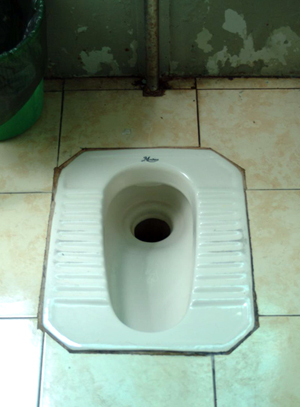
This morning we had to report in shifts for the health check (necessary to secure an alien registration card), which brings me to the second item in Strange Things That Koreans Believe.  This exam included the works: height & weight, blood pressure, eye exam, blood work and a chest x-ray, all conducted in an assembly line of wide-eyed, green EPIK teachers.  I felt rather like a horse that was being looked over before purchase -- if I don't pass, will they not buy me?  We were told to fast for 6 hours before our designated examination time.  The strange thing about this was that water was also on the forbidden list.  I understand the need for fasting before bloodwork, and am accustomed to fasting for 8 hours rather than just 6.  But no water?  No coffee, no soda, sure.  But water??  And there was a pee test involved in the exam, which proved rather difficult for many people.  They gave us a small (perhaps 6 oz) container of orange juice after the phlebotomists had finished with us, but when you haven't had any water since the night before (and in my case are even more dehydrated from drinking the previous evening), your body just sucks that up like a sponge.  Nothing goes through, at least not for quite a while.  Add to that the fact that my exam shift wasn't until 11am and the toilets made available for our use were squatters, and I had some serious issues with peeing in a cup.  Now I'm no medical professional, but I can't see what purpose this served.  Perhaps they just wanted to make sure they got a very concentrated urine sample, which they certainly did from me.

I'm sure there must be some weird/unfounded stuff that Americans or other westerners believe, too, but as an insider it's hard for me to think of any.  Anyone else know of something?  Or perhaps have an insight into the water ban?

Oh, who am I kidding.  I'm going to bed now.  I'll study my Hangul later.  I need to rest my brain so I can make it through a full day of classes tomorrow.


Thursday, August 19, 2010

Never underestimate the importance of pictures

I made it!  Safely, soundly and surprisingly uneventfully.  My international flight experiences are never so simple and smooth, so I'm probably in for it on the trip home.  In the mean time, I'm just thankful that both I and my luggage made it through more than 30 straight hours of travel in one piece.  And without going completely stir crazy.

I've already had my first run-in with cultural differences.  When we boarded the buses to take us from Incheon/Seoul airport to Jeonju for orientation, 8 volunteers were requested to help load luggage on the bus.  I hopped up and went to take my place in the luggage-loading assembly line, at which point the Korean coordinator came up to me and told me that I was the first lady ever to volunteer for that job.  I'm not sure whether that was a nice way of saying "Ladies can't carry luggage" or "You're bucking the system" or if he was simply making an observation.  Either way, it seems I've already overstepped the traditional Korean boundaries for women.  That didn't take long.

I am currently at Jeonju University for a week of orientation, where I will presumably learn how to teach Korean kiddies and survive in a country where I am, at least for now, functionally illiterate.  I have never been so grateful for the little pictures that accompany the words on signs before.  Want to claim your bags at the airport?  Follow the little picture of a suitcase.  Want to find the stairwell rather than wait on the elevator?  Follow the sign with a man running up stairs.  If it weren't for these things, I would be unable to complete the most mundane of everyday tasks (or it would take me two to three times as long).  Case in point: the a/c unit in our room.  It can only be controlled with a remote control, which has no pictures.  We just press buttons until it does what we want it to (sort of.  It seems to only run for so long before it shuts itself off, leaving me to wake up gasping in a puddle of sweat.)  It's a strange feeling, not being able to read.  And even if I could read Hangul, I wouldn't know what any of the words meant.  I have a lot of studying ahead of me.

Upon arrival, we were handed gift bags with an EPIK towel and an alarm clock, both wrapped neatly in pretty paper; some snacks and water; and 3 books somehow related to Korean education and getting by in Korea, all of which I'm sure we'll have to read.  This won't be a lazy man's orientation week.

This is our room.  It's much nicer than I had expected.

I'm staying in a dorm with a large chunk of other EPIK teachers.  My roommate is from Canada, and so far I've also met teachers from South Africa, Ireland, England.....my accent-loving cup runneth over.
The Korean bathroom - no shower, just a shower area and drains in the floor.
One of the desk/storage areas

The view from our window (14th floor)
I know the placement's not so nice looking on those photos - I'm still learning the quirks of this bloggy thing.  And speaking of the internets, can anyone tell me how to make my Google searches show up in English???

Both meals we've had so far have been decent.  We're eating in the dorm cafeteria.  Kimchi, rice and some sort of tofu soup alongside canned peaches, strangely-colored scrambled eggs and slightly soggy toast.  I'm not sure if the eggs and toast are standard or if EPIK is just trying to make us feel more at home.  More kimchi, more rice, potatoes, sweet-ish pickles, macaroni salad, bulgogi, more soups and some slightly unusual-tasting yet yummy spaghetti at lunch.  And watermelon and peach tea - for the US southerners?  It seems they put a variety of vegetables in everything, regardless of what the traditional recipe calls for (see spaghetti, scrambled eggs and macaroni salad).  It also seems that no coffee or related drink (tea, coffee "beverages" in a can at convenience stores, etc.) comes with any less sugar than it takes to rot the teeth out of your head on the spot.  I skipped the chopsticks at breakfast but tackled them at lunch.  Koreans use metal chopsticks, which I find more difficult to manipulate than the wooden kind.  But I certainly won't starve, and there are the fork and spoon backups.

I'm off to the opening ceremonies now, map in hand, which is really just a big, complicated picture.


Monday, August 16, 2010

Language is awesome.

For those of you who wonder why, exactly, I get so damned excited about language, I present this article.  I find this sort of thing more fascinating and exciting than I know how to express.

Lost in Translation: New cognitive research suggests that language profoundly influences the way people see the world (WSJ)

I wonder how I'll look at the world differently after my year in Korea.


Saturday, August 14, 2010

This might be tougher than I thought...

Almost every interaction I've had with EPIK so far has been great, and I've been impressed with the efforts and planning that goes into the program.  The pre-orientation course was fantastic, giving me extremely useful information (in a fun and interesting format) while also beginning to get me accustomed to Korean culture simply through its appearance and structure ("You must finish your learning!").  The information packet for arrival and the week of orientation is superbly detailed yet concise.  There is also a Canadian-born coordinator for native English teachers in my city who sent a wonderful welcome email.  Things like this make me even more excited about the upcoming year.  Then I read things like this little gem.  This is great information for me to have.  I'm very glad to have it, and I'm sure it will help me immensely.  But it also makes me realize that I'm up for more severe culture shock than I'd realized.

I am a fairly assertive person, independent, [insert other problematic qualities here].  You know, your basic city-dwelling American woman who can get shit done.  I would tend to view many of the expected and accepted behaviors described in the posting linked above as immature and/or unprofessional, and likely keep the person exhibiting those behaviors at arms length.  Obviously this will not be a productive way to deal with Korean working culture.  To make matters more difficult, I have been very fortunate in my supervisors so far, so I am not accustomed to dealing with personality conflicts in the workplace. I am used to working around/pushing though bureaucracy rather than just letting it happen once I've started the process.  I pride myself in solving problems with another person by sitting down and having a respectful dialogue rather than just rolling over.  I can respect the position that a person holds, but I don't put much stock in rank for the sake of rank.  Hierarchy, in my opinion, has its place, but I'll be damned if I will allow someone to walk on me just because (s)he is farther up the chain of command.

A helpful tidbit that a former coworker found useful when working with people from Asia: There are three genders: men, women, and American women.  We really are an entirely different breed in the eyes of a huge portion of the world.

So I guess I will be relying heavily on my ability to adapt (I think I have that ability).  I'll play the game to some extent and find a way to look at this that doesn't make me feel degraded, helpless, etc.  My current strategy: See this as a lesson in backroom politics.

Also, Korean language/writing is incredibly difficult but also kind of awesome.  All of the consonants in Hangul are designed to reflect the shape of the mouth when the sounds are made.  This is probably the coolest thing I have heard in a very long time.  And all of the little letter symbols fit together like a puzzle to form syllables.  I am so lost and frustrated, but I am so fascinated.  I guess in the end it's all ok, since my guide over at Kimchi Icecream says things will go better for me at work if I don't speak Korean (or don't let on that I've learned any if I can figure this stuff out).


Tuesday, August 3, 2010

Things done and things left undone

My Notice of Appointment has arrived, my visa is on its way in the mail, and I have moved out of my apartment and said farewell to my city.  I guess this technically makes me homeless.  I'm staying with my parents and hanging out with the family for a couple of weeks, including a quick beach trip and my friend's wedding in Nashville, before I fly out on August 17th.

I am still waiting for my TEFL exam to be graded and my certificate to arrive, and for an elf to show up and teach me how to make this blog look the way I want it to by magically imparting to me all knowledge of HTML while I'm asleep.  I'm sure I could learn this myself if I put my mind to it.  However, if I'm going to spend brainpower studying right now, I'm going to spend it on finishing the linguistics textboook that Kat loaned me or plowing through the Rosetta Stone Korean package that the choir gave me as a bon voyage gift.  So yeah, any pretty-blog-making advice that anyone can offer would be great.

The only bad news at this point is that my poor fat kitty, who had been taken into a new foster home by a very generous woman, can no longer stay in this new foster home.  Apparently the other kitty with prior claim to the home is none too pleased with Sabina's presence, and has made this fact quite clear by transferring her litterbox activities to the bed.  This is not acceptable, so Sabina must now be transferred to....someplace.  I just don't know where yet.  I'm rather worried.  Poor fat kitty.

On a more positive note, I am spending the next couple of weeks enjoying a lot of things that I couldn't in DC and probably won't in Korea:
Swimming in a pool that is not filled with hundreds of other people
Taking a hot bath in a tub that's large enough my legs don't stick out
Cuddling cats that don't try to kill me when I pick them up
Sauerkraut (The German equivalent of kimchi. It's my heritage.)

Ok, I probably ought to do some real work now.  Like knocking out some of the 15 units on developmental psychology and survival Korean that are part of the required pre-orientation course for EPIK.  I will also be shopping, packing and generally freaking out.  You may or may not hear from me again before I arrive in Korea, but leave some love in the mean time!